


Up Close with A Doll’s House at Masquerade Theatre
by Ash Kotter

I can say with confidence that theatre enthusiasts typically first meet Henrik Ibsen’s A Doll’s House in a classroom, as a staple of dramatic history, as something you read to discuss later and analyze. And, rightfully so, considering its cultural context: Ibsen wasn’t exactly being subtle in dramatizing a wife walking out on her husband and children in 1879. I probably read this play in high school. I’m sure I definitely read it in college. Could make a strong guess that I did a scene or two from it in various scene study classes.
Sitting next to a dear friend (and theatre professor!) on opening night of Masquerade Theatre’s production of A Doll’s House, we both realized that for all our familiarity with this play, we had never actually seen it staged. And as I sat down to write this review, I had to laugh at being so hilariously and embarrassingly on brand for myself: after finally getting to see a play I’ve only ever studied… I basically volunteered to do homework about it 😅
Writing a review in recognition of your peers is, of course, a different task than an academic analysis. Still, I found myself wondering whether it would be helpful or harmful that I’ve already been taught what to look for, and how that would shape my perception. I couldn’t really walk in empty-handed, already carrying the framework with me. The gender roles. The quiet (and not so quiet) ways Nora is treated as something to be managed, not met. The idea of a woman existing inside her own life as something decorative, something performative. I knew to watch for Nora’s shift. I was waiting for the moment she sees it for herself. I was waiting for the famous door slam.
But sitting in Masquerade’s incredibly small and highly exposed black box, my intellectual familiarity didn’t prepare me for how the dynamics actually play out between people while watching the text come alive. Under Jake Hufner’s direction, with Assistant Director Courtney Bundens, the Helmer house is meticulously controlled. As the action unfolds just a few feet away, dynamics and character definitions have nowhere to hide.

Allison Korn Grivas stuns as Nora Helmer, leveraging a distinct poise in posture, speech, in every way she engages with the world. Adorned in jewelry from head to toe, this version of Nora knows exactly how she is meant to be seen and leans into it fully. Grivas’s connection to the text is palpable, never throwing away a single line, creating a Nora who feels carefully constructed within the literal dollhouse-inspired world of the Helmer home. The moment of the tarantella dance felt especially striking, making her husband’s insistence that she’s performing it incorrectly all the more frustrating to watch. Watching something so clearly embodied be dismissed in real time becomes its own kind of tension.
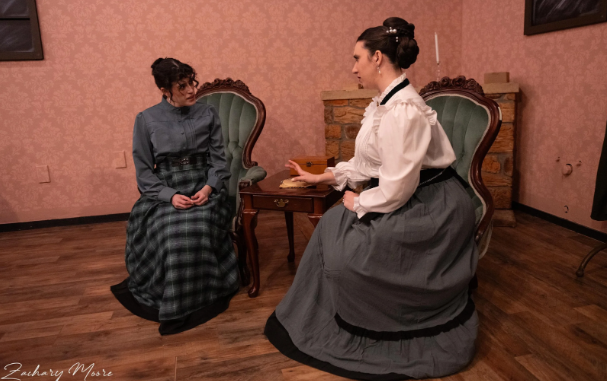
Sara Viniar gives us a reserved and gentle Christine Linde, an independent widow and girlhood friend of Nora’s. She listens with patience, even as Nora speaks indulgently about her own life and glazes over Christine’s losses before returning the focus to herself. When she reaches to reignite the Krogstad flame, Viniar’s earnest performance points to Christine’s independent desire in this choice, rather than it being a duty expected of her. Viniar also carries steadiness beneath her gentleness; when she challenges Nora, she discerns far more than she says and chooses not to soften the reality of what needs to be confronted.

Phyllis Josephson’s Anne moves dutifully in and out of the space, understanding exactly where she stands within the household. It’s in the small moments, a look, a shift in tone, a response just slightly more weighted than expected, that Josephson shines. Being reminded that Anne left her own child to raise Nora adds weight to her presence. Both Anne and Nora are, in different ways, shaped by what they’re expected to sacrifice. Abigail Balne (Emmy) and Lillian Balne (Ivar) appear briefly and sweetly as the Helmer children, giving us innocent moments of children needing their mother and playing hide-and-seek (and, the best stink face I ever did see, pointed straight at Krogstad).

Dan Wolfe as Nora’s husband, Torvald Helmer, delivers a matter-of-fact portrayal, a choice which allows the playwright’s criticisms of the world to speak plainly. It’s hard not to scoff at the patronization of Torvald’s words alone: “This evening I will be wholly and absolutely at your service, you helpless little mortal.” The certainty in his performance reinforces Torvald’s worldview, as he often gestures and physically engages with Nora as a father would with a child, more authoritative than affectionate. Thanks to intimacy coordination by Sean McGarry, it’s especially clear when Torvald drinks and shifts into expecting more traditionally “wifely” affection from Nora. The contrast underscores that intimacy in their relationship is far from mutual; it is conditional. Colby Crawford’s Krogstad establishes clear stakes early with a menacing directness. Especially skilled at navigating tone, pace, and timing, Crawford later reveals a softer side of the character, pointing to a man’s capacity for change. Mike Godwin’s Dr. Rank offers a counterbalance to Torvald’s rigid control through his affable, composed demeanor (despite the character’s self-proclaimed “wretchedness”).

Perhaps here is where my pre-existing familiarity comes into play. I already knew where the discomfort was about to arrive; I could feel a moment turning before it fully landed. Because of that, I found myself wishing I were given more time to linger in that discomfort. Just as a tense beat began to breathe, the action moved steadily forward to the next. Perhaps also, that’s a choice. There’s something to be said for not lingering, for allowing those moments to pass rather than settle, which creates a different kind of audience experience. In a play rooted so deeply in the slow realization of what has always been true, I wanted to stay in those shifts. By the time you’re reading this review, this strong ensemble will have had several performances to settle into a lived-in rhythm. My viewing carried the familiar forward momentum of an opening night, and there’s every reason to believe those moments have deepened and expanded as the run approaches its closing weekend.
The design choices create a compelling visual contrast: the Helmer house (set by Robert Schaeffer and scenic painting by Courtney Bundens) romanticizing domestication in warm pinks and antique florals, while the costumes (Jane Gerber) remain largely grayscale, with subtle use of greens. The result places the characters in a world that feels fuller than they do. Lighting design by Tommy Balne is intentionally restrained in favor of realism, relying on direct transitions rather than a stylized or atmospheric approach, serving the proximity between actor and audience.
In his director’s note, Hufner reflects on the play’s lasting impact and the cultural ripple of this famous final moment. The door slam that has echoed through over a century of theatrical history, once shocking to late 19th-century audiences, now feels inevitable. It carries a poignant weight when it’s no longer just a written stage direction. In this space, with this team, it felt less like a brash statement and, very aptly, more like the very assured and confident sound of Nora closing the door behind her.
A Doll’s House runs through March 21 at Masquerade Theatre - tickets here: https://www.simpletix.com/e/principal-series-a-doll-s-house-tickets-226094


